
Announcements

Shifting to the Left: The Rise of Sinn Féin in the 2020 Irish General Election by Kennedy Fiorella

2022-06-13

This paper seeks to determine, how do the results of the 2020 General Election indicate Ireland’s shift towards an increasingly progressive voter base? 

In the last election, Sinn Féin, the democratic socialist and Irish republican left-leaning party, won a majority of the vote at 24.5% the highest since the election of 1923, a significant 10.17% increase from the 13.8% achieved in the 2018 election. 

The objective of this research is to analyze the electoral results, secondary sources, and news sources to assess what led to Sinn Féin’s historic results in the 2020 Irish election, and what has led to the increase in progressive politics in Ireland.

Read more about Shifting to the Left: The Rise of Sinn Féin in the 2020 Irish General Election by Kennedy Fiorella

Current Issue

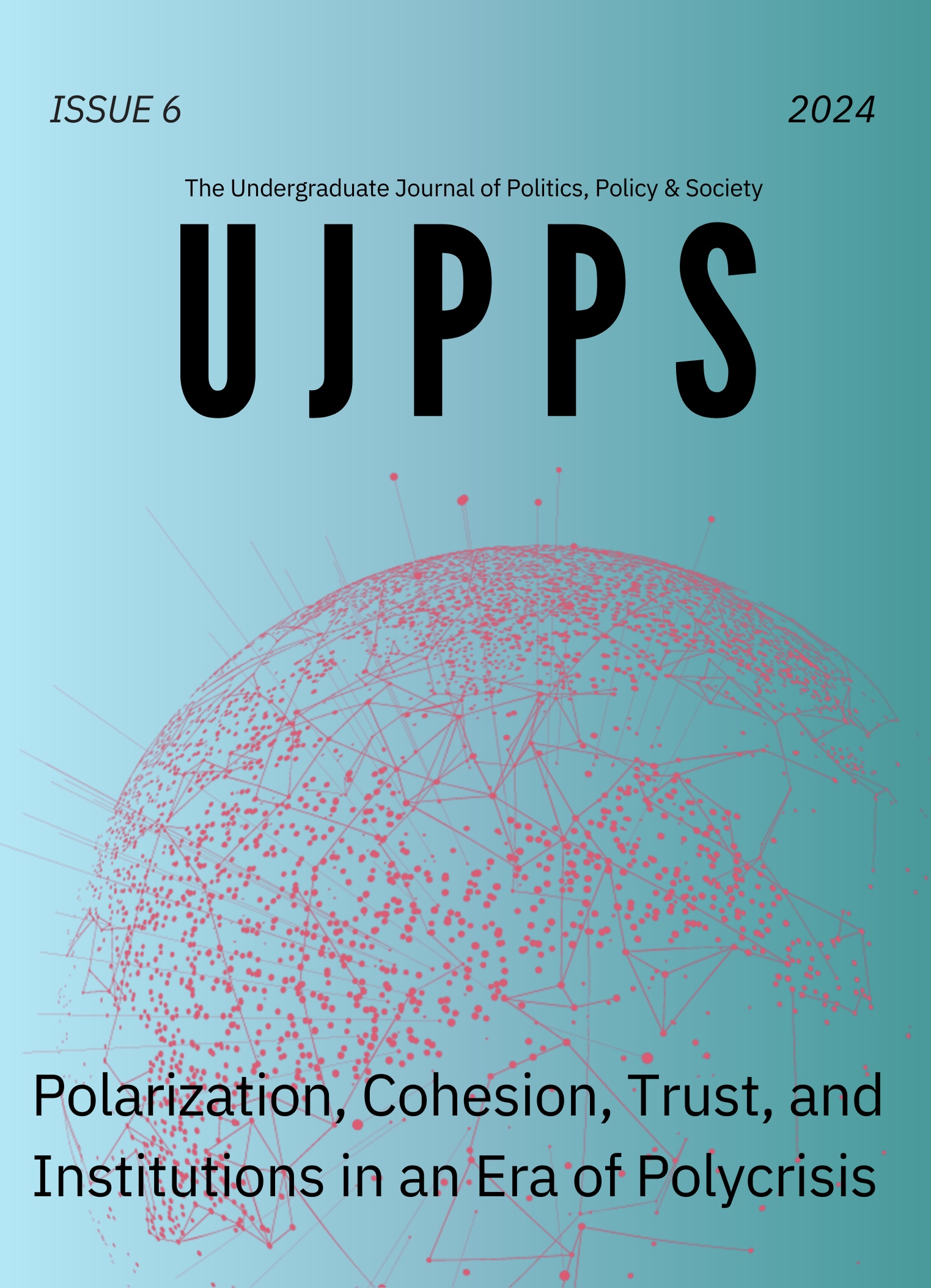
Vol 6 No 1 (2024): Polarization, Cohesion, Trust, and Institutions in an Era of Polycrisis

The 2024 issue explores the theme of Polarization, Cohesion, Trust, and Institutions in an Era of Polycrisis. This theme is relevant as current global systems are increasingly defined by several interacting crises crossing ecological, social, economic and technological domains–known as “polycrisis” (Søgaard Jørgensen et al., 2024). The COVID-19 pandemic, the Russo-Ukrainian war, and the growing climate crises require multidisciplinary strategies. These challenges raise critical questions about the role of polarization, trust, and cohesion in shaping the resilience of democratic institutions and global governance. The ten contributions to this issue from all over the world including the University of Bern (Switzerland), Corvinus University of Budapest (Hungary), University of South Alabama (USA), and Nanyang Technological University (Singapore) provide insight into how these dynamics interact within the rapidly evolving environment of the 21st century.

Published: 2024-12-28

Full Issue

View All Issues

UJPPS Call for Papers 2026

The Undergraduate Journal of Politics, Policy and Society (UJPPS) is an interdisciplinary academic journal that publishes peer-reviewed work of undergraduate students in social sciences and humanities. The journal provides a platform for aspiring academics to gain experience in publishing, research, and critical thinking while contributing to current debates and discussions in their disciplines. The UJPPS is currently soliciting submissions in the form of original research articles and literature reviews for its upcoming issue. The theme of the 2026 issue is The State of Democracy in an Age of Technological Innovation.

For much of the modern era, democracy has been a mode of political organization, a means of securing political participation, individual rights, human dignity, stability, and collective prosperity for all. Yet, democracy has a short history. As Kagan (1991, p. 2) describes it, democracy is a “rare, delicate and fragile” phenomenon. Over the past decade, democratic recession, the rise of populism, the re-emergence of wars, and the changing international world order have coincided with unprecedented technological innovation.

Technology has always shaped political life, but its importance has increased since the turn of the 21st century. Fundamentally altering the conditions under which political power is exercised, new algorithmic systems have reshaped how individuals access information, organize collectively, and meaningfully participate in political life. Be it artificial intelligence, social media, or utility systems, technology has become a tool through which politics is conducted, produced, distributed, and contested.

The relationship between technology and democracy is resultingly complex and contradictory. Although technological innovation expands political participation and collective action, it simultaneously creates new mechanisms for political manipulation, surveillance, polarization, and control. We welcome submissions that explore the connection between the state of democracy and technological innovations. Prospective articles can be qualitative or quantitative, from any theoretical or methodological perspective, addressing phenomena such as democratic backsliding, political and social fragmentation, declining trust in institutions, surveillance, disinformation, populism, or mass politics, to name a few. Possible questions that authors might address include:

  • Can democracy remain a viable mode of political organization in an environment where technological systems increasingly mediate political participation, public discourse, and access to information?
  • Is technological innovation democratic or anti-democratic?
  • Can technological innovation be controlled or does it control us?
  • How might democratic backsliding in the digital age differ from historical forms of democratic erosion?
  • What are the legal, socio-economic, and environmental consequences of technological innovation?
  • What are the safety concerns that can arise through the integration of artificial intelligence into commercial, social, and political services?
  • How has social media changed political life?
  • Is digital activism different from traditional forms of activism?
  • How does technology give various actors more or less political agency?

Interested authors should submit their manuscript via the journal's homepage, where they can also find the submission guidelines. The submission deadline is November 1st, 2026.

Submissions can be written in French or English and must be between 3,000 and 10,000 words in length. All submissions must conform to the journal’s submission guidelines. Submissions will undergo a double-blind peer-review process, and those selected by the UJPPS editorial team will be revised, finalized, and published in the 2026 issue of the journal. Questions pertaining to this call should be directed to daniel.stockemer@uottawa.ca.

We look forward to your submissions!

UJPPS Editorial Committee 2026